
Heat transfer vinyl (HTV) and permanent vinyl may look similar on a roll, but they use different adhesive systems and are built for different jobs. HTV uses heat and pressure to bond a design onto compatible textiles. Permanent vinyl uses a pressure-sensitive adhesive for suitable smooth, rigid surfaces.
Short version: garments (T-shirts, hoodies, jerseys, uniforms) → HTV. Hard surfaces (tumblers, glass, windows, signs, metal) → permanent vinyl. The rest of this guide explains why, and how to choose within each category.
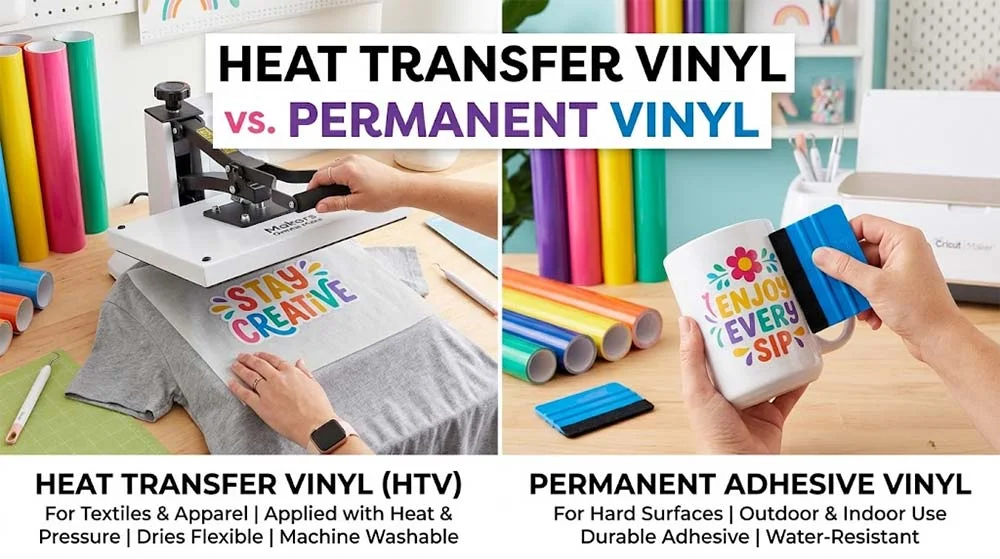
HTV vs Permanent Vinyl at a Glance
| Feature | Heat Transfer Vinyl (HTV) | Permanent Vinyl |
|---|---|---|
| Bonding method | Heat-activated adhesive | Pressure-sensitive adhesive |
| Application | Heat press or suitable iron | Peel, transfer and press onto the surface |
| Heat required | Yes | No |
| Main use | Garments and textiles | Smooth hard surfaces |
| Cotton / polyester / stretch fabric | Suitable with a compatible HTV | Generally not recommended |
| Glass / metal | Specialty products only | Common application |
| Transfer tape | Usually not required | Usually required |
| Mirror before cutting | Normally yes | Normally no |
| Carrier | Usually a clear PET carrier | Usually a paper backing |
| Repeated washing | Designed for compatible washable textiles | Not designed for it |
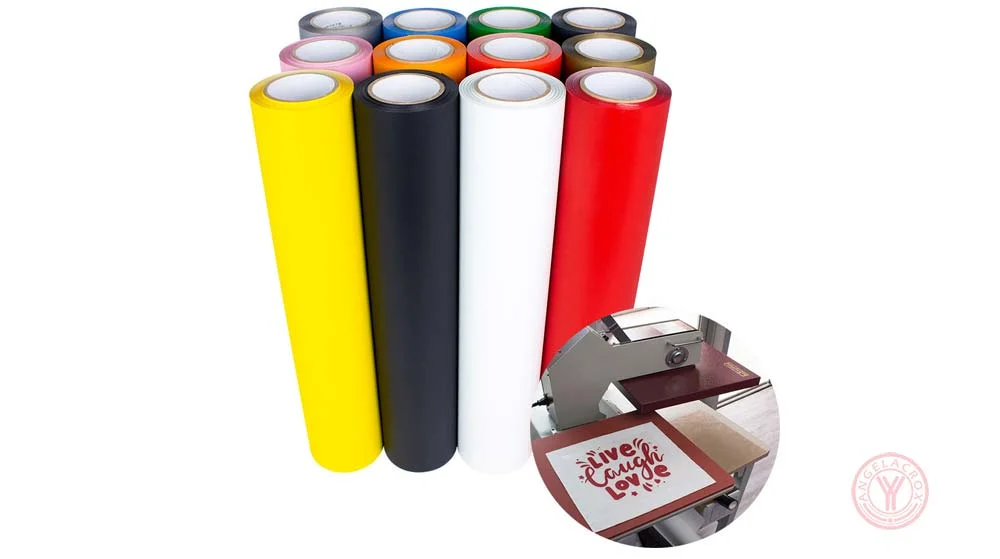
What Is Heat Transfer Vinyl?
Heat transfer vinyl, commonly called HTV or iron-on vinyl, is a specialty film for transferring graphics onto compatible textiles using controlled heat and pressure. A typical construction has a colored or decorative film layer, an adhesive layer and a carrier sheet. The vinyl is cut with a cutting plotter, weeded and positioned on the garment; heat and pressure then activate the adhesive and bond the design to the fabric — which is why HTV holds up as a garment bends, stretches and is washed.
Common applications: T-shirts, hoodies, sports jerseys, team uniforms, workwear, promotional apparel, tote bags, canvas products.For details, please read "What is Heat Transfer Vinyl"
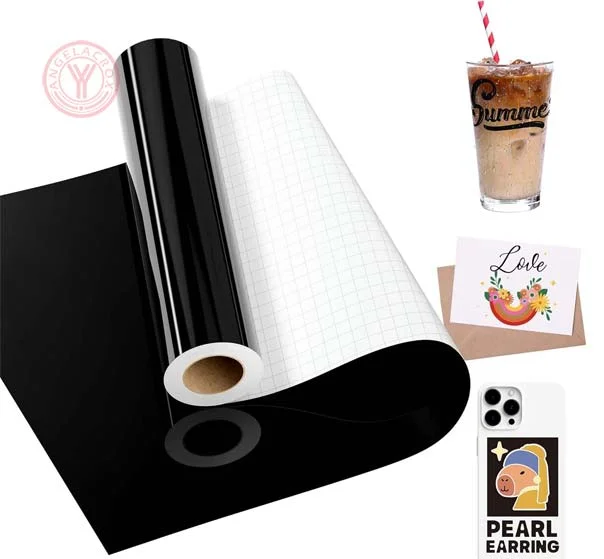
What Is Permanent Vinyl?
Permanent vinyl (permanent adhesive vinyl) is a self-adhesive film designed primarily for smooth, relatively rigid surfaces. Instead of heat, it uses a pressure-sensitive adhesive: cut, weed, then transfer to the target surface — usually with transfer tape.
Common applications: glass, tumblers, windows, metal signs, smooth plastic or wood, equipment labels, decals.
Note: "permanent" describes the adhesive category, not a guarantee. Surface prep, substrate compatibility and exposure conditions all affect how well it actually holds.
5 Key Differences
1. Adhesive System
HTV uses a heat-activated adhesive — heat softens or activates it while pressure sets the bond. Permanent vinyl uses a pressure-sensitive adhesive that bonds on contact with a suitable surface.
2. Application Method
HTV is normally applied with a heat press (some products also work with a household iron, if the manufacturer allows it). Permanent vinyl skips the heat press entirely: cut, weed, transfer, press firmly.
3. Substrate Compatibility
| Application | Preferred Starting Point |
|---|---|
| T-shirt / hoodie / jersey / uniform / canvas bag | HTV |
| Tumbler / glass / window / metal sign / smooth plastic | Permanent Vinyl |
4. Cutting, Mirroring and Transfer
HTV is normally cut mirrored — skip this and the finished graphic reads backward after transfer. Permanent vinyl is cut in the normal orientation and typically moved to the surface with transfer tape.
5. Flexibility and Washing
Garments bend, stretch and get washed repeatedly. A correctly selected HTV is built for that. Permanent vinyl isn't designed for the same stretching and wash cycles, which is why it's not the preferred choice for clothing.
Choosing by Application
| Project | Recommendation |
|---|---|
| T-shirts / hoodies | HTV — select by fabric, stretch level and desired finish. |
| Sports jerseys | HTV — check polyester compatibility and dye-migration resistance for dyed fabrics. |
| Workwear / uniforms | HTV — verify durability under frequent washing before bulk production. |
| Tumblers | Permanent vinyl — applies without a heat press. |
| Glass / windows | Permanent vinyl — choose a product rated for the intended indoor/outdoor exposure. |
| Metal signs | Permanent vinyl — confirm surface prep and environmental exposure first. |
Two clarifications worth keeping in mind: permanent vinyl may initially stick to fabric, but that's not the same as surviving repeated washing — HTV remains the better fit for apparel. And standard garment HTV shouldn't be assumed to work on glass or metal; that needs a product specifically engineered for the substrate. The practical rule is to match the vinyl construction and adhesive system to the actual substrate, not to treat either material as universal.
Choosing HTV by Fabric
| Fabric | What to Consider |
|---|---|
| Cotton | Most standard PU and TPU HTV works well; follow the product's pressing spec. |
| Polyester | Confirm polyester compatibility and dye-migration resistance where needed. |
| Cotton/poly blends | Select HTV by blend ratio and heat sensitivity. |
| Stretch fabrics | Use a flexible HTV designed to move with the fabric. |
| Sportswear | Weigh stretch, dye migration, wash conditions and final hand feel. |
| Workwear | Weigh wash frequency, durability and required finish. |
Typical HTV Application Specifications
These reflect common YANYAN HTV options — not a universal setting for every product. Always follow the specific instructions for the material you're using.
| Parameter | Typical Specification |
|---|---|
| Material | PU / TPU / PVC / PET |
| Width | 50 cm, customizable |
| Roll length | 25–50 m depending on product |
| Thickness | Approx. 0.08–0.30 mm, customizable |
| Application temperature | Approx. 140–165°C (284–329°F) |
| Pressing time | Approx. 8–15 seconds |
| Pressure | Medium, product dependent |
| Peel | Warm peel or cold peel, product dependent |
| MOQ | Selected products from 1 roll |
How to Choose the Right Material for Production
- Identify the fabric — cotton, polyester, blend or stretch; this drives adhesion, heat tolerance and HTV selection.
- Define the required appearance — matte, gloss, glitter, metallic, flock, reflective, holographic, puff or another finish.
- Check application conditions — available heat press, temperature range, pressure control; heat-sensitive garments may need a lower-temperature product.
- Check performance requirements — flexibility, wash conditions, dye migration, expected service environment.
- Test on the actual fabric — a sample run before bulk production catches problems early.
- Confirm bulk specs — color, width, thickness, finish, roll length and packaging once the sample is approved.
Common Mistakes
- Choosing by appearance alone. Two films can look identical but use different adhesive systems — check the construction and intended substrate.
- Using permanent vinyl on frequently washed clothing. Initial adhesion isn't the same as surviving repeated wash and stretch cycles.
- Reusing the same HTV settings for every fabric. Temperature, pressure and time should follow the product spec and be verified against the actual fabric.
- Ignoring polyester dye migration. Some dyed polyester can bleed color into the graphic — select a product designed to resist it and test first.
- Skipping the sample stage. A small test run surfaces compatibility issues before they become a production-scale problem.
- Treating "permanent" as a guarantee. Long-term adhesion still depends on surface prep, substrate compatibility and environment.
YANYAN: Manufacturing and Custom Services
YANYAN, established in 2001, manufactures heat transfer vinyl and related materials for apparel makers, garment businesses, printers, brands and wholesale buyers — factory-direct, with OEM/ODM support.
| Service | Detail |
|---|---|
| Custom color matching | Pantone reference or physical sample, depending on product |
| Pre-production samples | Standard stock: ~1 working day. Custom: ~3 working days |
| Bulk production time | ~7–15 working days; complex custom work may take longer |
| MOQ | Selected standard products from 1 roll; custom MOQ varies |
| Certifications available | OEKO-TEX, REACH, RoHS, CE, CPSIA, ISO, CA Prop 65 (product dependent) |
| Shipping | Express, air, sea, rail — by order size and destination |
YANYAN Heat Transfer Vinyl Options
- PU Heat Transfer Vinyl
- TPU Heat Transfer Vinyl
- 3D Puff Heat Transfer Vinyl
- Silicone Heat Transfer Vinyl
- Glitter Heat Transfer Vinyl
- Metallic Heat Transfer Vinyl
- Flock Heat Transfer Vinyl
- Reflective Heat Transfer Vinyl
- Holographic Heat Transfer Vinyl
- Patterned Heat Transfer Vinyl
- Glow in the Dark Heat Transfer Vinyl
- Printable Heat Transfer Vinyl
- Chameleon Heat Transfer Vinyl
Frequently Asked Questions
What is the main difference between HTV and permanent vinyl?
HTV bonds to compatible textiles with heat and pressure; permanent vinyl bonds to suitable smooth surfaces with a pressure-sensitive adhesive.
Which is better for T-shirts?
HTV. It's designed for compatible textiles and heat application; permanent vinyl is generally not recommended for regularly washed garments.
Can you iron permanent vinyl?
No — permanent adhesive vinyl isn't designed as an iron-on. If a project needs heat and pressure, use HTV instead.
Does HTV need a heat press?
A heat press is recommended for consistent commercial results, though some HTV products can be applied with an iron if the manufacturer's instructions allow it.
Do you mirror HTV, or permanent vinyl?
Mirror HTV before cutting. Permanent vinyl is cut in its normal orientation.
Does either need transfer tape?
Most standard HTV doesn't — the carrier sheet holds the design. Most permanent vinyl applications do use transfer tape to move the weeded design to the surface.
Can HTV be washed?
Yes, when a compatible product is properly applied. Actual wash performance still depends on the material, fabric and care process.
Which vinyl is best for polyester or sports jerseys?
HTV compatible with polyester; for dyed fabrics, also check dye-migration resistance.
What temperature and time does HTV need?
Typically 140–165°C (284–329°F) for about 8–15 seconds, but always defer to the specific product's instructions.
Can HTV go on glass, or permanent vinyl on tumblers?
Standard garment HTV isn't suited to glass — use a product engineered for that substrate. Permanent vinyl is commonly used on suitable tumbler surfaces.
Which is easier to apply?
Permanent vinyl, for hard-surface decals, since it skips the heat press. HTV needs controlled heat and pressure but suits garment decoration better.
Can YANYAN provide custom HTV, colors, and samples?
Yes — OEM/ODM with custom color, size, thickness, material and finish. Standard samples ship in about 1 working day; custom samples in about 3.
What's the MOQ and production time?
Selected standard products are available from 1 roll; custom products may need a different MOQ. Bulk production typically takes 7–15 working days.
Need Help Choosing the Right Heat Transfer Vinyl?
Send YANYAN your fabric information, artwork requirements, desired finish and estimated quantity, and we'll recommend a suitable HTV and provide a sample before bulk production.