
If you've sourced heat transfer materials before, you already know the terms get used loosely. "Iron-on" and "heat transfer vinyl (HTV)" are often the same product wearing two different names — one aimed at hobbyists, one at commercial buyers. But that surface-level answer isn't enough when you're placing a purchase order for 10,000 units and need to know which substrate will survive 50 industrial washes without cracking.
This guide comes from the production side, not the craft-blog side. We run heat presses daily, log wash-test failures, and field the same sourcing questions from garment decorators, promotional product distributors, and private-label brands every week. Below is what we tell them.
The Short Answer
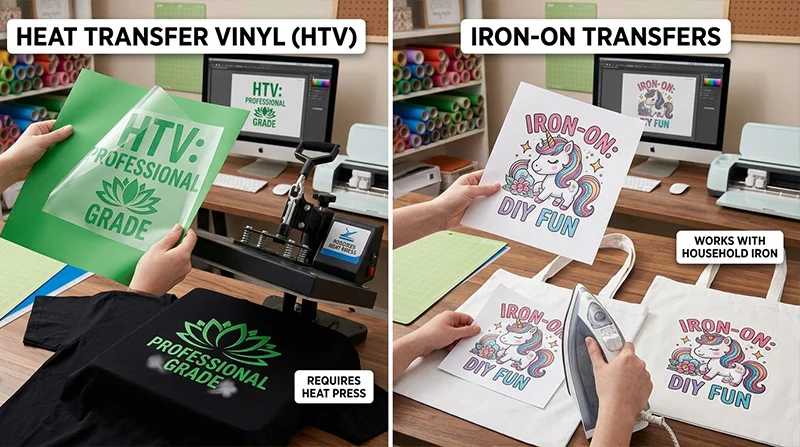
Heat transfer vinyl and iron-on material are functionally the same category — a heat-activated film that bonds pigment or color to fabric under pressure. The naming split is commercial framing, not a material difference: consumer machine brands market it as "iron-on" to signal it works with a household iron, while manufacturers and print shops call it heat transfer vinyl (HTV) to reflect its use with commercial heat presses and roll-to-roll production. What actually varies — and what matters for a purchase order — is the substrate chemistry (PU film vs. PVC vs. paper-based transfer) and the press specification it requires, not the label on the roll. If you're new to the material itself, our breakdown of what heat transfer vinyl is made from and how it's produced covers the resin types and film structure this comparison builds on.
Why This Distinction Matters at Production Scale
Most comparison content online is written for a single T-shirt project — someone printing one design on one shirt with a home iron. That framing breaks down at production scale for three reasons we see repeatedly in buyer inquiries:
Press consistency, not iron heat. A household iron can't hold a stable temperature or apply even pressure across a 12" x 40cm print area. At volume, temperature drift of even 10–15°F changes adhesion outcomes across a batch, which is why every spec sheet we issue is written for heat press parameters, not iron settings.
Wash durability is a spec, not a guess. Buyers ask "will it last," but the real question is "how many wash cycles, at what water temperature, before edge lift or cracking." Vague durability claims are the single most common gap we see in existing online comparisons — see the AATCC test methods directory for the standard our wash data below is based on.
Cost-per-unit math changes with material choice. PU-based HTV typically costs more per square inch than iron-on transfer paper, but paper transfers usually have a lower wash-cycle ceiling — so the "cheaper" option can raise total cost of ownership on a repeat-order garment program.
Technical Comparison
The table below reflects the parameters we actually put on our internal spec sheets. If you're evaluating suppliers, ask for numbers in this format — a supplier who can't provide wash-cycle or press-parameter data hasn't tested the product under production conditions.
| Parameter | PU Heat Transfer Vinyl | PVC Heat Transfer Vinyl | Iron-On Transfer Paper |
|---|---|---|---|
| Base material | Polyurethane film | Polyvinyl chloride film | Paper carrier + ink layer |
| Application method | Heat press (roll-to-roll / platen) | Heat press | Inkjet/laser + iron or press |
| Press temp | 305–320°F / 152–160°C | 300–310°F / 149–154°C | 375–400°F / 191–204°C |
| Press time | 10–15 sec | 12–15 sec | 25–60 sec, two-stage |
| Pressure | Medium | Medium-firm | Firm |
| Hand feel | Soft, thin, garment-like | Slightly heavier | Stiffer, visible border |
| Layering / multi-color | Yes, weeded & layered | Yes, weeded & layered | Single pass, no weeding |
| Fabric compatibility | Cotton, poly, blends, some leather | Cotton, poly, blends | Primarily cotton-heavy blends |
| Wash durability* | 50+ cycles | 40–50 cycles | 15–25 cycles |
| Stretch recovery | Good — activewear-suited | Moderate | Poor — cracks on stretch |
| Unit cost at volume | Higher / sq. in. | Mid-range | Lowest / sq. in. |
| Best-fit use case | Activewear, fitted apparel | Uniforms, workwear | Short-run promo, samples |
*Wash-cycle figures vary by resin formulation, laundering method, and press parameters used at application. Figures shown are illustrative industry midpoints — request AATCC 135 or ISO 6330 wash-test data from your specific supplier before specifying material for a production run. [Replace with your own lab-tested figures before publishing.]
Application by Order Type
Activewear & fitted garments
Stretch recovery matters more than raw wash-cycle count here, since the film needs to flex with the fabric without cracking at the seams. PU-based HTV is the standard choice for this reason, not because it's inherently "better" but because its elongation properties match performance fabric behavior.
Corporate uniforms & workwear programs
These are repeat-order accounts, often with 100+ wash cycles expected over a garment's service life. This is where wash-durability data should drive the material decision more than upfront unit cost, since a program that reorders every quarter due to premature cracking costs more long-term than a slightly higher per-unit material spend.
Short-run promotional items & sampling
For a 50-unit trade show run or a one-off client sample, iron-on transfer paper's lower cost and faster turnaround usually outweigh the durability tradeoff, since the item isn't expected to survive dozens of wash cycles.
Children's & infant apparel
Beyond material selection, this category needs attention to compliance: look for OEKO-TEX Standard 100 or equivalent certification on the film itself, not just the base garment, since transfer films are a direct-skin-contact material on some product types.
A Simple Framework for Estimating Cost Per Unit
Buyers often compare vinyl roll price against transfer paper price and stop there, which misses the real cost driver. A more accurate framework:
Cost per unit =
(material cost per sq. in. × design area)
+ labor time per unit
+ expected reorder rate due to premature wear
A material that's 20% cheaper per square inch but has half the wash-cycle life on a program that reorders based on customer returns can end up costing more over a 12-month contract. This is the calculation we walk distributor clients through before quoting a program-level order, and it's worth running before locking in a supplier based on unit price alone.
Frequently Asked Questions
Can iron-on transfer paper be used in commercial production runs?
It can, but it's generally better suited to short runs and sampling. The lower wash-cycle ceiling and printer-based (rather than weeded, cut-vinyl) application method make it less consistent at scale compared to press-applied HTV.
Which material works best on dark fabrics?
Both PU and PVC HTV are typically available in opaque, white-backed formulations designed for dark garments. Standard inkjet-based iron-on transfer paper often needs a specific "dark garment" paper variant, since standard transfer paper is designed for light fabric with a transparent background.
Do I need a commercial heat press, or can a household iron work for a small production run?
A household iron can produce acceptable individual results, but it cannot hold the consistent temperature and even pressure needed for batch-to-batch uniformity. Any order beyond a handful of units should be applied with a calibrated heat press to avoid inconsistent adhesion across the batch.
What wash-test standard should I ask my supplier for?
Request results based on a recognized method such as AATCC 135 (dimensional changes in laundering) or ISO 6330, along with the number of cycles tested and the specific press parameters used to apply the sample. A supplier without this data hasn't validated the product for repeat-wear apparel.
Sourcing Note
If you're evaluating suppliers for a production-scale order, ask for the same data points outlined above — press parameters, wash-cycle results, and certification documentation — rather than relying on general product descriptions. Material specification sheets and sample yardage are available on request through YanYan; contact our team for program-level pricing and technical data sheets.
Penny
Production / QC Lead · YanYan
This guide is maintained by the production and quality-control team at YanYan, based on internal press-line testing and buyer inquiries handled through our wholesale sourcing desk. Figures are updated as new wash-test data becomes available.
References: AATCC Test Method 135 — Dimensional Changes in Automatic Home Laundering; ISO 6330 — Textiles, Domestic Washing and Drying Procedures; OEKO-TEX Standard 100.