
For most T-shirts, PU heat transfer vinyl (HTV) is the best overall choice. It offers a strong balance of softness, flexibility, easy cutting, easy weeding, reliable adhesion, and wash durability. However, the best HTV depends on the fabric, design, finish, and production requirements.
Quick Answer: What Is the Best HTV for T-Shirts?
There is no single heat transfer vinyl that is ideal for every T-shirt. The right material depends on the garment fabric, graphic size, desired appearance, stretch level, application temperature, washing requirements, and production volume.
For general T-shirt decoration, PU HTV is the best starting point for most applications. Its combination of a soft hand feel, flexibility, clean cutting, easy weeding, and reliable transfer performance makes it suitable for a wide range of apparel.
| Application | Recommended HTV | Main Reason |
|---|---|---|
| Most T-shirts | PU HTV | Soft, flexible, easy to weed, and versatile |
| 100% Cotton | PU HTV | Reliable adhesion and comfortable hand feel |
| Polyester | Polyester-compatible HTV | Designed for synthetic fabrics |
| Stretch T-shirts | Stretch PU HTV | Moves with elastic fabrics |
| Sportswear | Stretch or Reflective HTV | Suitable for activewear and visibility applications |
| Glitter designs | Glitter HTV | Adds a sparkling decorative effect |
| Metallic designs | Metallic HTV | Creates a metallic appearance |
| 3D designs | Puff HTV | Creates a raised effect |
| Textured designs | Flock HTV | Provides a soft, suede-like surface |
| Reflective designs | Reflective HTV | Provides a reflective visual effect |
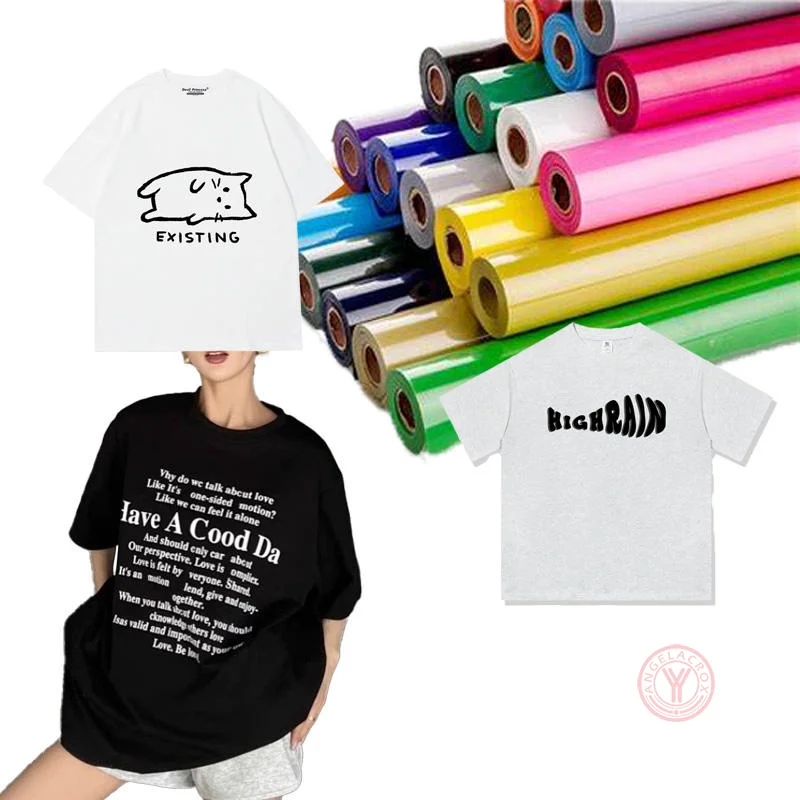
What Makes a Good Heat Transfer Vinyl for T-Shirts?
The best HTV should not be selected by color or price alone. For professional apparel production, the material should be evaluated throughout the entire decoration process, from cutting and weeding to pressing, washing, and repeated use.
Soft Hand Feel
A soft and flexible HTV creates a more comfortable garment, especially when the transfer covers a large area of the T-shirt. Thin PU HTV is often preferred when garment comfort is a priority.
Easy Weeding
Easy weeding is important for both individual projects and commercial production. Clean cutting and predictable weeding are particularly valuable for small text, logos, numbers, and detailed graphics.
Strong Adhesion
A quality HTV should bond consistently with the target fabric when the recommended temperature, time, and pressure are applied correctly. Good adhesion helps reduce peeling around edges and corners.
High Elasticity
For stretch garments, elasticity is an important performance factor. Stretch-compatible HTV should move with the fabric without cracking or separating during normal use.
Wash Durability
HTV durability should be evaluated after washing rather than judged only by its appearance immediately after pressing. The actual result depends on the HTV, garment, application conditions, and washing method.
Batch Consistency
Batch consistency becomes especially important for wholesale and repeat production. Color, thickness, adhesive performance, cutting behavior, and transfer results should remain consistent between production batches.
PU vs PVC vs TPU Heat Transfer Vinyl
Different HTV materials provide different combinations of flexibility, hand feel, thickness, durability, and application performance.
| Material | Main Characteristics | Best Applications | Considerations |
|---|---|---|---|
| PU HTV | Soft, flexible, lightweight, and easy to weed | General T-shirts, fashion apparel, logos, lettering | Select the correct grade for specialty fabrics |
| PVC HTV | More structured and available in different thicknesses and finishes | Economical and specialty applications | May have a firmer hand feel than thin PU |
| TPU HTV | Flexible, elastic, and suitable for specialized applications | Stretch garments and technical textile applications | Product-specific application settings are important |
Is PU or PVC HTV Better for T-Shirts?
For most T-shirts, PU HTV is generally preferred when softness, flexibility, and a lightweight finish are important. PVC HTV can still be useful when a thicker structure, particular finish, or different cost target is required.
The better choice ultimately depends on the garment, design, performance requirements, and target price.
What Is the Best HTV for Different T-Shirt Fabrics?
Best HTV for 100% Cotton T-Shirts
Cotton is one of the most commonly used fabrics for HTV applications. Standard PU HTV is a reliable option for logos, lettering, numbers, promotional graphics, and everyday T-shirt designs.
Before pressing, pre-pressing the garment can help remove moisture and smooth the application area. Always follow the recommended settings for the specific HTV.
Best HTV for Polyester T-Shirts
Polyester requires more attention because synthetic fabrics can be sensitive to heat and some garments may experience dye migration.
For polyester T-shirts, choose an HTV specifically tested for synthetic fabrics. When dye migration is a concern, consider a suitable dye-blocking or low-temperature HTV and test it on the actual garment before bulk production.
Best HTV for Cotton-Polyester Blends
Cotton-polyester blends are widely used for promotional apparel, uniforms, and everyday clothing. A general-purpose PU HTV may work well, but the actual fiber blend, garment finish, and surface treatment should be considered.
Best HTV for Stretch T-Shirts
For T-shirts containing spandex or elastane, choose a stretch-compatible HTV. High elasticity helps the transfer move with the garment during wearing and washing.
Best HTV for Nylon
Nylon can be more challenging than cotton because adhesion can vary depending on the fabric construction and surface treatment. Use an HTV specifically approved for nylon when required and test the exact garment before production.
Best HTV for Sublimated Polyester
Sublimated polyester requires special attention because dyes can migrate into a heat-applied transfer. A suitable dye-blocking HTV should be considered when working with sublimated garments.
What Is the Best HTV for Different T-Shirt Designs?
Best HTV for Logos
PU HTV is a versatile option for logos because it combines clean cutting, easy weeding, flexibility, and a soft finish.
Best HTV for Small Text
Thin PU HTV is usually a strong choice for small lettering and detailed graphics. Clean cutting and easy weeding are especially important for small design elements.
Best HTV for Large Designs
For large graphics, flexibility and hand feel become increasingly important. A lightweight PU HTV can provide a more comfortable finish than a thick transfer covering a large section of the shirt.
Best HTV for Sports Jerseys
Stretch PU HTV is suitable for many sports garments because it can move with the fabric. Reflective HTV can also be considered when visibility is part of the design requirement.
Best HTV for Fashion T-Shirts
Metallic, holographic, glitter, flock, foil, and puff HTV can create distinctive visual effects for fashion apparel and premium garment decoration.
Specialty Heat Transfer Vinyl for T-Shirts
Standard PU HTV is the best all-around option for many T-shirt applications, but specialty HTV is useful when a specific visual or functional effect is required.
| HTV Type | Effect | Typical Applications |
|---|---|---|
| Glitter HTV | Sparkling surface | Fashion apparel, event shirts, names, logos |
| Metallic HTV | Metal-like appearance | Premium logos and decorative graphics |
| Holographic HTV | Multi-angle reflective effect | Fashion, promotional, and decorative apparel |
| Puff HTV | Raised 3D appearance | Streetwear, fashion, statement graphics |
| Flock HTV | Soft textured surface | Premium lettering and logos |
| Reflective HTV | Reflective appearance | Sportswear, workwear, visibility applications |
| Foil HTV | Glossy metallic appearance | Decorative and premium designs |
HTV vs DTF for T-Shirts: Which Is Better?
HTV and DTF are both useful garment decoration technologies, but they are designed for different production requirements.
| Factor | HTV | DTF |
|---|---|---|
| Best for | Cut graphics, logos, lettering, and specialty finishes | Detailed full-color graphics |
| Color effects | Strong specialty finish options | Excellent full-color printing |
| Small text | Very good with suitable thin HTV | Very good |
| Solid-color graphics | Excellent | Excellent |
| Production process | Cut, weed, and press | Print, powder, cure, and press |
| Specialty finishes | Strong advantage | More dependent on printing materials |
If the design mainly consists of solid colors, names, numbers, logos, or specialty effects, HTV remains highly practical. If the artwork requires complex photographic or full-color printing, DTF may be a better production solution.
How Professional HTV Should Be Tested
A professional HTV evaluation should go beyond asking whether the transfer sticks to a T-shirt. For commercial production, the material should be evaluated throughout the complete application process.
1. Cutting Test
Check whether the HTV cuts cleanly at practical blade settings without damaging the carrier film.
2. Weeding Test
Test both large shapes and difficult details, including small text, narrow lines, and internal cutouts.
3. Transfer Test
Apply the HTV according to its recommended temperature, time, pressure, and peeling conditions.
4. Adhesion Test
Inspect edges, corners, and fine details after cooling and handling. Poor adhesion may indicate incorrect settings or fabric incompatibility.
5. Stretch Test
For stretch garments, repeatedly stretch the decorated area and check for cracking, lifting, or loss of adhesion.
6. Washing Test
Wash the finished garment under a defined washing procedure and inspect the transfer for peeling, cracking, fading, or other changes.
7. Batch Consistency Test
For repeat production, compare samples from different batches for color, thickness, cutting, weeding, adhesion, and transfer behavior.
Important: Wash durability depends on the HTV material, garment, application settings, and washing conditions. Product-specific test results should always be evaluated under defined conditions.
How to Choose HTV for Bulk T-Shirt Production
Choosing HTV for hundreds or thousands of T-shirts is different from choosing vinyl for one personal project. In commercial production, labor efficiency, consistency, waste, and rework can have a major impact on the final cost.
Consider Total Cost, Not Just Roll Price
A lower-priced roll is not necessarily the lower-cost option if it produces more weeding waste, cutting problems, application failures, or rework.
Total Cost Per Finished Shirt = Material + Cutting + Weeding + Pressing + Waste + Rework
Consider Production Efficiency
Easy weeding, predictable cutting, consistent transfer performance, and a stable application window can reduce labor time when production volume increases.
Test Repeat Orders
For customers who reorder the same color or material, batch-to-batch consistency is critical. A reliable supplier should be able to maintain stable specifications over time.
Request Samples Before Bulk Production
Sample testing is particularly important for polyester, nylon, blended fabrics, sublimated garments, and stretch apparel.
Confirm Roll Specifications
For wholesale purchasing, confirm roll width, roll length, film thickness, carrier type, packaging, carton configuration, and labeling before placing a production order.
How to Evaluate a Heat Transfer Vinyl Supplier
The best HTV is only useful when the supplier can provide stable quality and dependable production support. For B2B buyers, evaluate the supplier as carefully as the material itself.
| Supplier Factor | What to Check |
|---|---|
| Manufacturing Experience | How long has the supplier been producing HTV and related transfer materials? |
| Samples | Can samples be tested before a bulk order? |
| MOQ | Can the supplier support the required trial or production quantity? |
| Quality Control | How are thickness, color, adhesive, and transfer performance controlled? |
| Batch Consistency | Can repeat orders maintain consistent color and application performance? |
| Certifications | Which certifications and compliance documents are available? |
| Customization | Can colors, sizes, thicknesses, finishes, packaging, or other specifications be customized? |
| Lead Time | What is the normal production lead time for samples and bulk orders? |
| OEM / ODM | Can the supplier support customized or private-label requirements? |
| Logistics | Can the supplier support sea, air, railway, or express shipping? |
Why Manufacturer Experience Matters When Choosing HTV
HTV performance is influenced by more than the visible color of the film. Film formulation, thickness control, adhesive performance, carrier construction, and production consistency can all affect the finished garment.
YanYan has more than 20 years of experience in heat transfer material manufacturing. Our product range includes standard and specialty heat transfer vinyl for different apparel decoration requirements.
For B2B customers, our approach focuses on material selection, sample testing, production consistency, and application requirements rather than simply selecting the lowest-cost vinyl.
Depending on the product, available options can include different materials, finishes, colors, sizes, and thicknesses. OEM and ODM requirements can also be supported for suitable projects.
Selected YanYan HTV products have demonstrated durability through 60+ industrial wash test cycles, depending on the specific product and defined test conditions.
How to Apply Heat Transfer Vinyl to a T-Shirt
Step 1: Prepare the Artwork
Prepare the design according to the cutting method and mirror the artwork when required by the HTV.
Step 2: Cut the HTV
Use suitable blade depth, cutting pressure, and speed for the specific HTV material.
Step 3: Weed the Design
Remove unwanted vinyl while keeping small details, lettering, and graphic elements intact.
Step 4: Pre-Press the T-Shirt
Pre-press the garment to help remove moisture and smooth the application surface.
Step 5: Position the Design
Place the transfer accurately on the garment and ensure that the application area is properly positioned on the heat press.
Step 6: Apply Heat and Pressure
Use the temperature, time, and pressure recommended for the specific HTV product.
Step 7: Peel the Carrier
Follow the product-specific hot peel, warm peel, or cold peel instructions.
Step 8: Follow Garment Care Instructions
Allow the garment to stabilize according to the manufacturer's instructions before washing.
Note: Heat press settings vary between HTV products. Do not assume that one temperature or pressing time works for every material.
Common HTV Problems and Troubleshooting
| Problem | Possible Cause | What to Check |
|---|---|---|
| Edges are lifting | Insufficient heat, pressure, or time | Verify the product's recommended application settings |
| Vinyl is cracking | Incorrect material for stretch fabric or improper application | Use stretch-compatible HTV and test elasticity |
| Weeding is difficult | Incorrect cutting settings or film characteristics | Adjust blade depth and cutting pressure |
| Color changes after pressing | Heat-sensitive material or garment interaction | Test the material on the actual fabric |
| Dye migration | Garment dye moving into the transfer | Use suitable dye-blocking HTV when required |
| Uneven adhesion | Uneven pressure or garment surface | Check heat press pressure and garment positioning |
| Different results between orders | Material or production variation | Check batch consistency and supplier quality control |
Best HTV for T-Shirts: Simple Decision Guide
| If You Need... | Start With... |
|---|---|
| A versatile HTV for everyday T-shirts | PU HTV |
| A soft and lightweight finish | Thin PU HTV |
| Stretch performance | Stretch PU HTV |
| A sparkling finish | Glitter HTV |
| A metallic appearance | Metallic HTV |
| A holographic effect | Holographic HTV |
| A raised 3D effect | Puff HTV |
| A soft textured surface | Flock HTV |
| Reflective graphics | Reflective HTV |
| Complex full-color graphics | Consider DTF |
Frequently Asked Questions About the Best HTV for T-Shirts
1. What is the best heat transfer vinyl for T-shirts?
For most T-shirts, standard PU HTV is the best overall option because it balances softness, flexibility, easy weeding, adhesion, and durability. The ideal material still depends on the garment and design.
2. What is the best HTV for cotton shirts?
PU HTV is a strong choice for cotton shirts and is suitable for logos, lettering, numbers, and general graphics.
3. What is the best HTV for polyester shirts?
Choose an HTV specifically tested for polyester. For garments with dye-migration risk, a suitable dye-blocking or low-temperature product may be necessary.
4. Is PU or PVC HTV better?
PU is generally preferred when softness and flexibility are important. PVC can be useful for applications requiring a different thickness, structure, finish, or price point.
5. Is PU HTV good for T-shirts?
Yes. PU HTV is one of the most versatile options for T-shirt decoration and is suitable for many everyday apparel applications.
6. Can HTV be used on polyester?
Yes, but polyester requires an HTV grade compatible with synthetic fabrics. Dye migration and heat sensitivity should be considered.
7. Can HTV be used on stretch fabric?
Yes. Use stretch-compatible HTV for garments containing spandex or elastane.
8. What HTV is best for sports jerseys?
Stretch PU HTV is a suitable starting point for sports jerseys. Reflective HTV is another option when visibility is required.
9. What HTV is best for small text?
Thin PU HTV with clean cutting and easy weeding is generally preferred for small text.
10. What HTV is best for large designs?
A lightweight flexible PU HTV is often a good choice because large transfers can otherwise feel heavy or stiff.
11. What HTV is best for glitter designs?
Glitter HTV is designed specifically for sparkling decorative effects.
12. What HTV is best for metallic designs?
Metallic HTV provides a metallic surface and is suitable for premium logos, fashion graphics, and decorative apparel.
13. What HTV creates a 3D effect?
Puff HTV creates a raised three-dimensional effect after pressing.
14. What HTV is best for reflective designs?
Reflective HTV is designed for graphics that require a reflective visual effect under suitable lighting.
15. How durable is HTV on T-shirts?
Durability depends on the HTV, garment, application, and washing process. Product-specific wash testing provides the most meaningful durability information.
16. Can HTV withstand industrial washing?
Some commercial HTV products are designed for demanding washing conditions. Selected YanYan HTV products have demonstrated durability through 60+ industrial wash test cycles under defined test conditions.
17. Does HTV work better with a heat press or an iron?
A heat press is generally preferred for professional and repeat production because it provides more consistent temperature, pressure, and timing.
18. Why is my HTV peeling after washing?
Possible causes include insufficient heat, pressure, or pressing time, incorrect peel timing, fabric incompatibility, or improper washing conditions.
19. Why is my HTV cracking?
Cracking can occur when the vinyl is not suitable for a stretch garment or when application conditions are incorrect.
20. How do I prevent HTV from peeling?
Use a compatible HTV, prepare the garment properly, follow the recommended temperature, time, and pressure, and use the correct peeling method.
21. Should I test HTV before buying in bulk?
Yes. Sample testing is strongly recommended, especially for polyester, nylon, stretch fabrics, blends, and sublimated garments.
22. What should I ask an HTV supplier?
Ask about material composition, specifications, MOQ, samples, certifications, quality control, batch consistency, lead time, customization, and shipping options.
23. Does HTV thickness matter?
Yes. Thickness affects hand feel, flexibility, cutting, weeding, and the appearance of the finished garment.
24. Does HTV work on cotton-polyester blends?
Yes, but compatibility should be confirmed with the specific fabric blend and garment finish.
25. Can HTV be used on sublimated shirts?
Yes, but dye migration must be considered. A suitable dye-blocking HTV should be evaluated for sublimated polyester garments.
26. What is the difference between HTV and DTF?
HTV is cut and heat applied, making it excellent for solid-color graphics and specialty finishes. DTF is printed and transferred, making it more suitable for complex full-color artwork.
27. Is HTV suitable for wholesale T-shirt production?
Yes. HTV is suitable for wholesale apparel production when the material is selected for the garment and the application process is properly controlled.
28. What MOQ should I expect for wholesale HTV?
MOQ varies by supplier, material, size, color, and customization requirements. Some HTV products can be supplied from small trial quantities, while customized production may require a higher MOQ.
29. Can HTV colors be customized?
Many HTV manufacturers can support customized colors depending on the product and order quantity.
30. Can HTV size and thickness be customized?
Yes. Depending on the material and production requirements, width, roll length, and thickness can be customized.
31. Does YanYan provide HTV samples?
Yes. YanYan supports sample requests so buyers can evaluate the material on their actual garments before bulk production.
32. Does YanYan support OEM and ODM HTV?
Yes. OEM and ODM support is available for suitable HTV products and customized production requirements.
33. What certifications are available for YanYan HTV?
Depending on the product, available certifications and compliance documentation can include ISO, CE, RoHS, OEKO-TEX, CPSIA, and California Proposition 65-related compliance.
Final Recommendation: Which HTV Should You Choose?
If you need one versatile material for everyday T-shirt decoration, start with PU HTV. It provides a practical combination of softness, flexibility, easy weeding, reliable adhesion, and durability.
For specific applications, choose the material according to the garment and design. Use stretch PU for elastic fabrics, polyester-compatible HTV for synthetic garments, dye-blocking HTV for sublimated polyester, glitter for sparkle, metallic for premium effects, puff for 3D designs, flock for texture, and reflective HTV for visibility.
For commercial or wholesale production, the most important question is not simply “Which HTV is the cheapest?” A better question is:
“Which HTV provides consistent results at the lowest total production cost?”
That means evaluating cutting, weeding, transfer performance, fabric compatibility, wash durability, batch consistency, supplier reliability, and sample performance before committing to a large order.
About YanYan HTV
YanYan is a heat transfer material manufacturer with more than 20 years of manufacturing experience. We provide standard and specialty heat transfer vinyl for apparel decoration, including PU HTV, PVC HTV, TPU HTV, glitter HTV, metallic HTV, holographic HTV, puff HTV, flock HTV, reflective HTV, and other specialty transfer materials.
For B2B buyers, YanYan supports flexible MOQ options, sample testing, OEM/ODM projects, mixed orders, customized specifications, and international shipping solutions.
View the full range of Heat Transfer Vinyl (HTV) products and contact YanYan for product samples or bulk sourcing requirements.