
UV printable heat transfer vinyl is a specialized printable film engineered to accept UV-curable inks directly, enabling full-color graphics, raised 3D badges, and textured brand logos to be heat-transferred onto apparel, headwear, luggage, and accessories. However, choosing the right film requires matching the substrate structure to the end product rather than selecting a material by thickness or surface finish alone.
PU (polyurethane) and thick TPU (thermoplastic polyurethane) UV printable vinyl can both be used for custom garment and accessory branding, but they serve different structural needs. Final performance depends on the base polymer, film thickness (ranging from 0.12mm to 1.8mm), surface texture, UV ink curing settings, cutting method, and heat press application parameters.
For everyday apparel graphics that require a lightweight, flexible feel, a soft PU-based printable film is often a practical starting point. For structured 3D crest patches, sportswear badges, caps, and bags, selecting a UV printable vinyl in thick TPU or textured PU provides stronger dimensional stability and edge definition. As with any industrial heat transfer material, the most reliable workflow is to align the film specification with your UV printer, cutter, and fabric, and complete a sample press and wash test before bulk production.
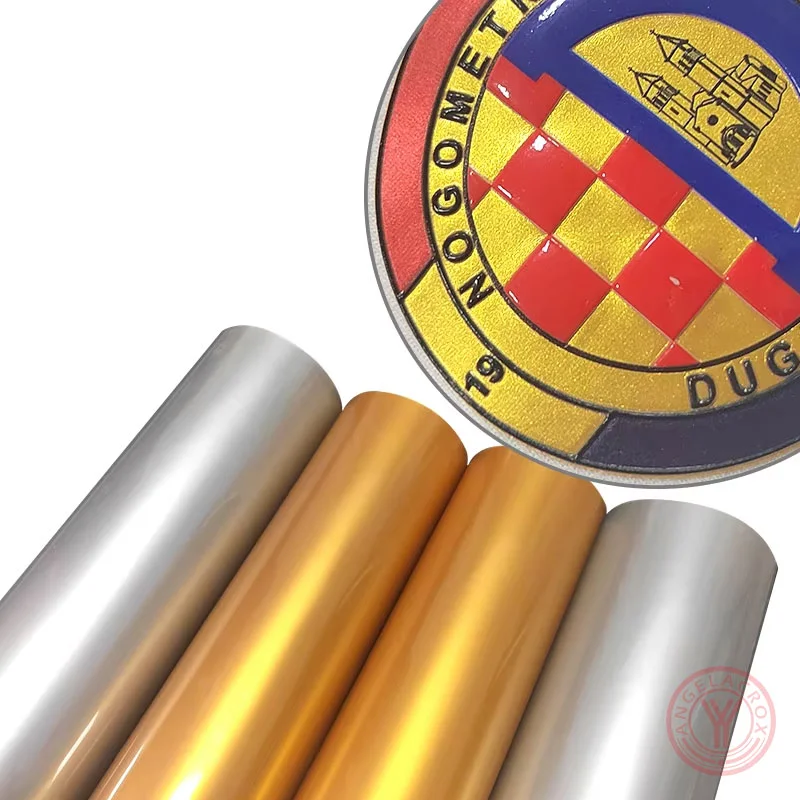
Why UV Printable Vinyl Needs Extra Care in Material Selection
Standard eco-solvent or aqueous printable vinyl is designed to absorb liquid solvent inks into a microporous coating. By contrast, UV printing cures ink instantly on the film surface using ultraviolet LED lamps. If you run a standard printable HTV through a UV printer, the cured ink layer can become brittle, crack when flexed, or flake off during washing because the coating was not formulated for UV ink cross-linking.
A dedicated UV printable heat transfer vinyl uses a modified PU or TPU surface layer that promotes strong chemical adhesion with flexible and semi-flexible UV inks while withstanding both laser/blade cutting and 150°C–160°C (302°F–320°F) heat pressing.
Important: UV ink flexibility varies by ink series and UV lamp curing power. Even when using a high-grade PU or TPU UV printable film, excessive UV lamp wattage or overly thick varnish layers can reduce stretchability. Always test ink adhesion, bending resistance, and wash durability on the actual substrate before approving mass production.
Production Factors That Can Affect UV Printable HTV Results
- Base polymer and thickness: Films ranging from 0.12mm to 1.8mm behave very differently during cutting, weeding, and garment flexing.
- UV ink type: Soft or flexible UV inks are preferred for apparel fabrics, whereas standard rigid UV inks are only suitable for non-stretch badges, hats, or hard luggage.
- Cutting equipment: Thin films (0.12–0.5mm) cut cleanly on standard vinyl plotters, while heavy gauge films (0.7–1.8mm) may require high-downforce industrial cutters or flat laser machines.
- Surface texture: Sand glitter, brushed, holographic, mirror metallic, and 2D lenticular surfaces alter ink gloss and visual depth.
- Target substrate: Cotton, polyester, blends, leather, caps, and luggage require appropriate platen pressure and backing support during pressing.
Can Both PU and Thick TPU UV Printable Vinyl Be Used on Apparel?
Yes. Both PU and thick TPU UV printable vinyl are widely used on garments, headwear, and fabric accessories. However, polymer type and gauge thickness directly determine the visual profile, flexibility, and cutting workflow of the finished transfer.
In general production, PU UV printable vinyl is chosen when a softer hand feel, thicker matte white base, or specialty glitter texture is desired for apparel decoration. Thick TPU UV printable vinyl is preferred when high tensile durability, abrasion resistance, transparent/metallic optical effects, or a sharp 3D badge structure is required.
| Material Type | Typical Thickness & Roll Size | Typical Advantages | Important Limitations and Checks |
|---|---|---|---|
| PU UV Printable Vinyl |
0.5mm – 1.8mm (White/Matte White PU, 0.5mm Glossy/Matte Gold & Silver PU, 0.7–0.75mm Sand/Brushed Glitter PU). Roll: 1.35m × 25m (slittable to 67.5cm or 45cm). |
Offers a soft, cushioned hand feel, smooth ink absorption, vibrant color reproduction, and easy weeding for garment logos, fashion graphics, and textured patches. | For gauges above 1.0mm (such as 1.8mm White PU), verify cutter blade depth or flat laser cutting parameters to prevent charred or bevelled edges. |
| Thick TPU UV Printable Vinyl |
0.12mm – 1.0mm (0.25–0.7mm White TPU, 0.2–1.0mm Transparent TPU, 0.35–0.5mm Matte/Mirror/Laser Gold & Silver, Hologram, 2D Lenticular). Roll: 1.35m × 25m. |
Provides superior dimensional stability, scratch and water resistance, elasticity, and a crisp 3D raised badge appearance ideal for sportswear crests, caps, and bags. | Confirm compatibility between the TPU surface finish (especially mirror, laser, or transparent TPU) and your UV ink primer or white-ink underbase settings. |
| Standard Eco-Solvent Printable PU HTV |
0.08mm – 0.15mm thin apparel film. Roll: 50cm × 50m. |
Ultra-thin and lightweight for large chest or back T-shirt prints using eco-solvent or latex ink systems. | Designed primarily for eco-solvent inks rather than thick 3D UV badge applications; always match the film coating to your printer ink chemistry. |
When producing high-profile 3D emblems or multi-textured brand labels, do not choose between PU and TPU based on thickness alone. Evaluate how the surface finish interacts with your UV ink layer and whether the garment requires flexible drape or rigid badge structure.
Which UV Printable Vinyl Finish Is Best for Your Application?
Because UV printing allows selective white ink, CMYK color, and clear varnish layering, pairing the ink with a specialty base film creates visual effects that cannot be achieved with standard DTF or screen printing. Explore our full UV Printable Vinyl range to match specific product categories to your design goals. UV DTF sticker builds are a different process from UV-printed heat transfer film and the two are not interchangeable; for that route see the 3D embroidery UV DTF sticker guide.
| Application or Visual Goal | Recommended UV Printable Film | Available Thickness Options | Key Production Check |
|---|---|---|---|
| Classic full-color apparel logos and raised badges | White TPU or White / Matte White PU | 0.25mm, 0.35mm, 0.4mm, 0.5mm, 0.7mm (TPU); 0.5mm, 1.0mm, 1.8mm (PU) | Print CMYK directly without needing a heavy white ink underbase; verify cutter force for 1.0–1.8mm gauges. |
| Metallic team crests, luxury labels, and cap patches | Matte/Glossy Gold & Silver PU/TPU, Mirror Gold TPU, Laser Gold TPU, Matte Green Gold TPU | 0.35mm, 0.5mm | Use selective white ink under areas that require opaque color while leaving metallic areas unprinted for foil accents. |
| Sparkling fashion graphics and streetwear decals | Sand Texture Glitter PU/TPU or Brushed Texture Glitter PU (Gold, Silver, White) | 0.35mm (TPU); 0.7mm, 0.75mm (PU) | Adjust UV head gap slightly higher to clear the textured glitter surface cleanly during printing. |
| Iridescent, color-shifting, or dimensional emblems | Hologram Silver TPU or 2D Black+Silver Lenticular TPU | 0.12mm, 0.5mm (Hologram); 0.5mm (2D Lenticular) | Test ink transparency so the holographic or lenticular optical pattern remains visible through the printed artwork. |
| Clear edge-free badges and multi-depth layered logos | Fully Transparent TPU | 0.2mm, 0.3mm, 0.5mm, 1.0mm | Allows reverse printing or top printing with white ink backing for a floating 3D acrylic-like badge effect on garments. |
For buyers who also require non-printed dimensional effects such as heat-expanding puff or molded rubber textures, you can compare these options against our 3D Heat Transfer Vinyl collection.
Printing, Cutting, and Heat Press Settings for UV Printable Vinyl
Achieving clean edge definition and wash-durable bonding requires coordinated settings across three stages: UV printing, contour cutting (plotter or flat laser), and heat pressing. Because film thicknesses span from 0.12mm up to 1.8mm, a single press setting will not work identically across every specification.
Most PU and thick TPU UV printable vinyl products transfer effectively at approximately 150°C–160°C (302°F–320°F) for 10–15 seconds under medium pressure (45–50 PSI). Always use this as a baseline reference and adjust according to your specific film gauge and fabric thickness.
| Control Point | Recommended Practice | Why It Matters |
|---|---|---|
| Roll slitting & feeding | Order the master roll (1.35m × 25m) slit into 67.5cm (2 rolls) or 45cm (3 rolls) if using narrow-format UV printers. | Matching roll width to your printer media path prevents skewing and media buckling. |
| UV lamp curing | Use balanced LED curing power suited for flexible PU/TPU substrates rather than maximum high-heat curing. | Over-curing can make the UV ink film overly rigid and cause surface curling on thinner gauges. |
| Contour cutting | Use vinyl cutters (Graphtec, Mimaki, Roland, Cricut, Silhouette) for 0.12–0.7mm films; use flat laser or heavy-force blades for 0.75–1.8mm films. | Proper cutting tools ensure crisp badge borders without frayed edges or incomplete weeding. |
| Transfer temperature | Press at 150°C–160°C (302°F–320°F); verify platen temperature accuracy before running bulk garments. | Sufficient thermal energy is required to conduct through thick 0.5–1.8mm films and melt the bottom adhesive layer. |
| Pressing time & pressure | Apply for 10–15 seconds at medium pressure (45–50 PSI); for 1.0–1.8mm badges, an additional 5-second back press helps lock the adhesive. | Thick TPU and PU act as thermal insulators; back-side heating ensures full adhesive penetration into heavy fabrics. |
| Peel method | Follow the specific product structure for warm peel or cold peel after pressing. | Allowing thick 3D badges to stabilize before peeling prevents edge lifting or badge warping. |
Production tip: When heat-pressing thick UV-printed TPU or PU badges (0.7mm–1.8mm), place a thin protective PTFE or silicone pad over the printed surface. This distributes platen pressure evenly around the raised border of the badge and protects the UV ink texture from direct metal platen glare.
How to Test UV Printable Vinyl Before Bulk Production
Before running a commercial order of custom patches, sportswear jerseys, or branded bags, complete a full workflow test using your exact UV ink set, cutting equipment, and garment material.
Recommended UV Printable HTV Test Procedure
- Confirm the target fabric or substrate (cotton, polyester, cotton-poly blend, leather, or luggage fabric) and select the matching PU or TPU film thickness.
- Check the film surface for dust or static, set the correct UV print head height for the film thickness (0.12mm–1.8mm), and print a test swatch.
- Perform a cross-hatch tape test and a 180-degree fold test on the printed film to confirm UV ink adhesion and flexibility without cracking.
- Test-cut the contour on your vinyl plotter or flat laser machine, checking for clean weeding and smooth edge quality.
- Heat-press the sample onto the actual garment at 150°C–160°C (302°F–320°F) for 10–15 seconds at 45–50 PSI, adding a back-press if using heavy gauge film.
- Inspect the garment immediately after peeling (warm or cold as specified) for edge bonding, platen marks, or ink surface changes.
- Allow the sample to cure for 24 hours at room temperature, then conduct a wash test to verify scratch resistance, color fastness, and wash durability.
- Document the approved UV lamp power, pass speed, blade/laser settings, press temperature, time, and pressure for repeatable production.
Because YanYan supplies over 18 specialized UV printable finishes, we provide free samples (with only shipping cost required) and flexible MOQs starting from 1 roll so your team can validate print and wash performance before bulk purchasing.
Common UV Printable Vinyl Problems and How to Fix Them
1. UV Ink Cracks or Flakes When the Garment Is Stretched
This usually occurs when rigid UV ink is used on a flexible garment or when the UV LED curing power is set too high. Switch to a flexible or semi-flexible UV ink formulation, reduce excessive varnish thickness, and lower UV lamp intensity to the minimum level required for full ink curing.
2. Thick TPU or PU Badge Edges Lift After Washing
Thick films (0.7mm–1.8mm) slow down heat transfer from the top platen to the hot-melt adhesive layer. If the adhesive does not reach full activation temperature, edges will lift in the wash. Increase dwell time slightly within the 10–15 second window, verify 45–50 PSI pressure, and press from the inside-out back of the garment for 5–8 seconds.
3. Scorched or Yellowed Edges After Laser Cutting
When cutting thick PU or TPU UV printable vinyl on a flat laser machine, excessive laser power or slow travel speed can discolor white or metallic edges. Fine-tune laser frequency and speed, ensure clean air-assist extraction, or use a high-downforce drag-knife/tangential blade plotter for gauges up to 0.8mm.
4. Ink Smearing or Head Strikes During Printing
Sand glitter (0.7–0.75mm), brushed glitter, and 1.0–1.8mm PU/TPU films are significantly thicker than standard 0.1mm vinyl. Always recalibrate the media thickness setting and raise the carriage head gap on your UV printer before loading heavy-gauge rolls.
Frequently Asked Questions
What is the difference between PU and thick TPU UV printable vinyl?
PU UV printable vinyl is soft, lightweight, and cushioned, making it ideal for everyday apparel graphics and textured glitter finishes (available up to 1.8mm). Thick TPU UV printable vinyl offers stronger dimensional stability, high abrasion resistance, and crisp 3D badge structure, with options including transparent, mirror metallic, holographic, and 2D lenticular finishes.
What roll sizes and thicknesses are available for UV printable vinyl?
Our standard roll size is 1.35m × 25m per roll, which can be factory-slit into 2 rolls (67.5cm × 25m) or 3 rolls (45cm × 25m) to fit different printer widths. Thicknesses range from 0.12mm and 0.2mm up to 1.8mm depending on the selected PU or TPU style.
Which cutting machines are compatible with UV printable heat transfer vinyl?
It is compatible with flat laser cutting machines as well as popular vinyl cutting plotters including Graphtec, Mimaki, Roland, Cricut, and Silhouette. Select blade depth and downforce according to the exact film thickness.
What temperature and pressure should I use to press UV printable vinyl?
Recommended baseline settings are 150°C–160°C (302°F–320°F) for 10–15 seconds at medium pressure (45–50 PSI), followed by a warm or cold peel depending on the product structure. Always test the specific gauge and fabric before mass production.
What fabrics can UV printable vinyl be applied to?
It adheres reliably to cotton, polyester, cotton-polyester blends, leather, canvas, hats, and luggage fabrics when pressed with appropriate temperature and pressure.
What is your MOQ and can I order free samples before bulk production?
Our standard MOQ starts from 1 roll (1–10 rolls for custom specifications), and we provide free samples for pre-production testing with only shipping costs required. All products comply with ISO, CE, RoHS, CA Prop 65, REACH, and OEKO-TEX standards.
Key Takeaway
UV printable heat transfer vinyl bridges the gap between full-color digital printing and dimensional 3D garment branding. By choosing between soft PU and structured thick TPU—and matching the thickness (0.12mm–1.8mm) and surface texture to your artwork—you can produce durable, waterproof, and wash-resistant logos for apparel, headwear, and bags.
For everyday garment graphics and thick matte or glitter textures, evaluate PU UV printable options. For high-definition 3D crests, mirror metallic badges, holographic decals, or transparent multi-layer emblems, thick TPU UV printable vinyl provides the required structural performance.
If you are sourcing printable materials for UV printers and laser/plotter workflows, explore our complete UV Printable Vinyl catalog or browse our broader Heat Transfer Vinyl (HTV) solutions for custom OEM/ODM production.
The most reliable production result comes from matching your UV ink flexibility, cutting method, and heat press parameters through a documented sample test.
Editorial note: This guide provides practical general information. Always follow the latest technical data sheet and care instructions for the exact UV printable vinyl product, ink system, and garment being used.