
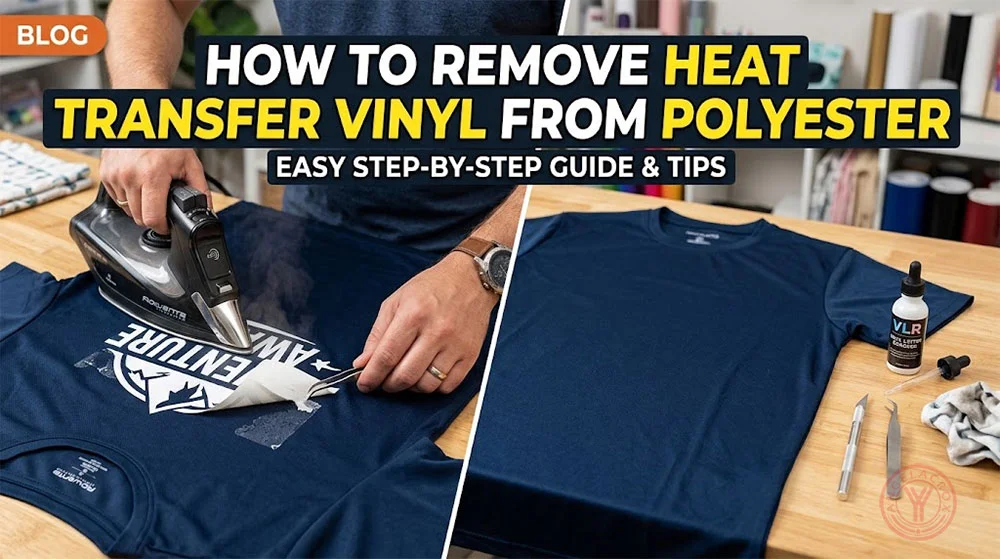
How to Remove Heat Transfer Vinyl From Polyester Without Damaging the Fabric
Short answer: You can sometimes remove heat transfer vinyl (HTV) from polyester, but complete, invisible removal is not guaranteed. Start with a concealed-area test, work from the back of the design in small sections, and use the mildest method that releases the adhesive. Polyester is more heat- and solvent-sensitive than cotton, so excessive heat, aggressive chemicals, or forceful pulling can leave permanent shine, distortion, dye change, or coating damage.
This guide is designed for standard polyester garments, including teamwear, performance shirts, polos, and polyester blends. It also explains when you should stop rather than risk making the garment worse.
Can You Remove Heat Transfer Vinyl From Polyester?
Yes, but the result depends on the film, adhesive, garment construction, and how long the design has been on the fabric. Thin polyurethane (PU) HTV on an untreated polyester knit is usually a better removal candidate than glitter, flock, reflective, printable, or heavily textured vinyl. A design that was pressed recently may also behave differently from one that has been washed and tumble-dried many times.
Even when the film lifts successfully, the fabric may retain a faint outline, adhesive residue, a pressure mark, or a difference in surface sheen. This is especially common on dark garments, smooth athletic fabrics, sublimated polyester, and garments with water-repellent or polyurethane-based surface treatments.
Important: Do not assume the temperature used to apply the vinyl is appropriate for removing it. Removal can require a different approach because the adhesive has already cured, aged, and bonded to the fabric.
Before You Start: Identify the Risks
Check the garment care label, then inspect the fabric and the transferred design. Polyester is a broad category: two garments labeled “100% polyester” can react very differently because of dyeing, knit structure, coatings, laminations, and finishing treatments.
| Garment or HTV condition | Risk level | What to do |
|---|---|---|
| Standard polyester T-shirt with thin PU HTV | Moderate | Test first, then work from the back in small sections. |
| Dark, bright, or high-saturation sportswear | Moderate to high | Watch closely for dye change, whitening, or surface gloss. |
| Sublimated polyester garment | High | Avoid extended heat and strong solvents; the print or surface appearance may change. |
| Water-resistant, PU-coated, laminated, or soft-shell polyester | High | Do not use aggressive solvents unless the manufacturer confirms compatibility. |
| Glitter, flock, reflective, printable, or thick HTV | Moderate to high | Expect layer-by-layer release and possible residue; do not pull hard. |
| Old HTV exposed to repeated dryer cycles | High | Adhesive may be strongly set or brittle; test one edge and reassess often. |
If the item is expensive, irreplaceable, or part of a uniform set, test only a small hidden edge first. Consider professional garment-care help if the garment has specialty coatings or valuable branding.
Tools and Materials
- Clean tweezers, a weeding hook, or a small blunt lifting tool
- White cotton cloths or lint-free wipes
- Cardboard, a pressing pillow, or another clean barrier to separate garment layers
- A polyester-compatible HTV remover, used exactly according to its product label
- Optional: isopropyl alcohol for a small compatibility test or light adhesive cleanup, not as a universal solution
- Optional: hair dryer for gentle, moving heat
- Mild laundry detergent
- Gloves and adequate ventilation when using any commercial remover
Do not start with acetone, nail-polish remover, paint thinner, or unknown industrial solvents. These products can damage polyester fibers, coatings, dyes, elastic components, logos, and trims. A product marketed as a vinyl remover should still be patch-tested, because “polyester” does not describe every coating or finish on the garment.
Lowest-Risk Method: Work From the Back of the Design
For many standard polyester garments, the lowest-risk starting point is to soften the adhesive from the reverse side of the print instead of applying high direct heat to the vinyl face. Work slowly and treat removal as a series of small tests, not a one-pass process.
1. Do a concealed-area test
Turn the garment inside out. Choose an inside seam allowance, hem, or covered area and apply a very small amount of the selected remover or alcohol to a white cloth. Dab the test area lightly. Let it dry completely, then inspect the fabric under good light.
Stop if you see color transfer onto the cloth, whitening, a sticky surface, loss of water repellency, stiffening, or a new glossy patch. These signs mean the garment finish or dye may not be compatible with the product you selected.
2. Protect the other side of the garment
Place cardboard or a clean barrier inside the shirt directly behind the design. This prevents remover, softened adhesive, or moisture from transferring to the opposite side of the garment.
3. Treat a small section from the reverse side
Apply a small amount of polyester-compatible remover to the back of one edge of the design. Use only enough to dampen the area; do not soak the full garment. Follow the remover manufacturer's dwell-time instructions. If no dwell time is provided, begin conservatively and check the area quickly rather than letting the product sit for an extended period.
4. Lift and peel at a low angle
Turn the garment right side out. Use tweezers to lift a loosened corner. Pull the film back slowly and nearly parallel to the fabric surface. A low peel angle puts less upward stress on the knit than pulling straight away from the garment.
If the film resists, stop pulling. Return to the back side, treat only the resistant section, and try again. Forceful peeling can stretch polyester yarns, create a permanent pressure mark, or tear the vinyl into fragments that are harder to remove.
5. Repeat in small sections
Continue a few centimeters at a time. Thick, glitter, flock, reflective, printable, and aged HTV may release in layers. That is normal. The goal is not to remove everything in one pull; it is to limit damage to the garment while gradually reducing the film and adhesive.
6. Let the garment dry and reassess
After the main film is removed, allow the area to dry fully before deciding whether more treatment is necessary. A damp polyester surface can temporarily look darker or glossier, which makes it difficult to judge the true result.
When Low Heat May Help—and When It Can Damage Polyester
Gentle heat can sometimes help loosen a resistant edge, but it is not the default answer for polyester. Concentrated heat can make polyester shiny, pucker the knit, distort the surface, or permanently set a pressure mark.
If you decide to use heat, use a hair dryer rather than a high-powered heat gun whenever possible. Keep it moving, warm only a small area for a short time, and immediately test whether the edge releases more easily. Avoid prolonged direct heating on dark, coated, sublimated, or performance fabrics.
If you use an iron or heat press, do not copy the original HTV application settings. Begin with the lowest practical temperature for the garment, use a protective sheet, apply brief test contact only, and inspect after every attempt. Stop at once if the fabric becomes shiny, puckered, hard, sticky, discolored, or visibly thinner.
Never leave a heat source in one place, and do not use a heat gun at close range. Heat damage to polyester may not be reversible.
How to Remove Adhesive Residue From Polyester
Residue is common after removing HTV, especially with older designs or specialty films. Start with the mildest approach and avoid trying to “scrub it off” quickly.
- Allow the garment to cool and dry before judging the amount of residue.
- Place the barrier back inside the garment.
- Use a clean cloth with a small amount of the remover that passed your patch test.
- Dab or roll the cloth over the residue. Do not grind the adhesive deeper into the knit.
- Lift softened adhesive gently with tweezers or wipe it away with a fresh section of cloth.
- Repeat only as needed, allowing the fabric to dry between passes.
- Wash the garment according to its care label after removal is complete.
Do not scrape aggressively with a blade. On smooth polyester, scraping can create a shiny abrasion that is more noticeable than the remaining adhesive.
Polyester Garments That Need Extra Caution
Sublimated polyester
Sublimated garments often contain vivid all-over graphics. Heat, friction, and some chemicals can change the fabric's appearance or reveal differences between the area under the HTV and surrounding fabric. Use minimal heat, patch-test any remover, and accept that a shadow or outline may remain.
Water-repellent and coated polyester
Jackets, bags, outerwear, and performance garments may have DWR, PU, TPU, or other coating systems. These finishes can become tacky, cloudy, glossy, or uneven after exposure to incompatible solvents. Do not assume a remover suitable for an uncoated polyester T-shirt is suitable for coated outerwear.
Recycled polyester and lightweight athletic knits
Lightweight fabrics can deform more easily during peeling, while recycled polyester may vary in construction and finishing. Keep mechanical stress low, support the fabric from behind, and stop if the knit begins to elongate or pucker.
Specialty HTV
Glitter, flock, reflective, holographic, printable, and thick films may have multiple layers. The face film can lift while adhesive remains on the garment. Work in stages and avoid judging success only by whether the top layer comes off.
Common Problems and What to Do
| Problem | Likely cause | Recommended response |
|---|---|---|
| Vinyl will not lift | Adhesive is still bonded, or the film is old or specialty material | Do not pull harder. Treat a smaller area from the back, reassess your remover, or stop if the garment reacts. |
| Vinyl tears into small pieces | Film is brittle, cold, aged, or layered | Work with a smaller edge and lift gradually. Avoid forceful peeling. |
| Sticky adhesive remains | Top film released before adhesive | Use small, controlled cleanup passes with a tested remover and fresh cloth. |
| Fabric becomes shiny | Too much direct heat, pressure, friction, or chemical exposure | Stop immediately. Do not add more heat or scrub harder; the change may be permanent. |
| Color appears lighter or transfers to cloth | Dye or finish is reacting to the solvent | Stop using that product and allow the item to dry fully before evaluating damage. |
| A visible outline remains | Pressure mark, dye difference, fabric compression, or adhesive shadow | This may not be removable. Avoid further aggressive treatment that could enlarge the affected area. |
Can You Apply New HTV After Removing the Old Design?
Possibly, but only after the garment is clean, fully dry, and free of active solvent or loose adhesive. Any residue can interfere with the next transfer and cause poor adhesion, bubbling, edge lift, or uneven texture.
Before applying a new design, inspect the area under good light. If the fabric has become glossy, damaged, or visibly different from the surrounding garment, a new transfer may make the difference more obvious rather than hide it. Test the new material on a separate area or sacrificial garment whenever possible.
For polyester jerseys, activewear, uniforms, and other heat-sensitive synthetic garments, use a transfer film with a suitable low-temperature application range and a compatible adhesive system. See our polyester heat transfer vinyl for performance apparel to review suitable material options before reapplying a design.
FAQs
Can I use acetone to remove HTV from polyester?
It is not a good starting choice. Acetone and nail-polish remover can damage polyester, coatings, dyes, trims, and nearby printed graphics. Use a product designed for vinyl removal only after a concealed-area compatibility test, and follow its label instructions.
Can I use a heat press to remove vinyl from polyester?
Heat may help in limited cases, but a heat press can easily create shine, distortion, or pressure marks on polyester. If you use one, treat it as a short, low-temperature test—not as a repeat of the original application process—and inspect the garment after each attempt.
Why is my polyester shirt shiny after I removed HTV?
Shine can come from excess heat, pressure, friction, or changes to a surface coating. It can also happen when the HTV compressed the fibers during the original application. Do not continue heating or rubbing the area, because that can make the sheen more visible.
Can HTV be removed from a sublimated polyester shirt?
It can sometimes be lifted, but sublimated garments are high-risk. Their printed surface and color appearance can change with heat, chemicals, and friction. Test a hidden area first and be prepared for a remaining outline or appearance difference.
Is it possible to remove glitter or flock HTV from polyester?
Sometimes, but these films are more likely to release in layers and leave adhesive behind. Remove them slowly in small sections and avoid forceful peeling. If the fabric begins to react, stop rather than chase a completely invisible result.
Should I wash the garment after removing HTV?
Yes. Once removal is complete, wash the garment according to its care label to remove any remaining solvent or loosened adhesive. Allow it to air-dry first so you can inspect the area before exposing it to dryer heat.
Final Takeaway
The best way to remove HTV from polyester is not the fastest or hottest method. It is a controlled process: identify the garment and film, patch-test first, work from the back in small sections, use minimal heat, and stop when the fabric shows signs of stress. Thin PU HTV on ordinary polyester may be removable with acceptable results, but specialty films, coated garments, and sublimated sportswear require a more conservative approach.
Need to replace the design after removal? Explore our heat transfer vinyl for sportswear, uniforms, polyester T-shirts, and other synthetic-fabric decoration projects.
Technical note: This article provides general garment-handling guidance rather than a guarantee of results. Film construction, adhesive chemistry, garment dyeing, coatings, age, laundering history, and transfer conditions all affect removability. Always follow the technical and safety instructions supplied with the specific HTV and removal product you use.