
Yes, heat transfer vinyl (HTV) can be used on polyester. However, the reliable answer depends on the specific garment, not only on its fiber label. A light-colored polyester T-shirt, a stretch performance shirt, and a sublimated team jersey can all be 100% polyester while requiring different films, application settings, and testing procedures.
PU, PVC, and TPU heat transfer vinyl can all be used on selected polyester garments, but they should not be treated as interchangeable materials. The final suitability depends on the specific film formulation, adhesive system, application temperature, garment color, fabric stretch, sublimation process, and surface finish.
For standard, non-sublimated polyester, an HTV specifically approved for polyester is often a workable option. For dark colors, bright athletic fabrics, sublimated jerseys, or water-repellent garments, the risk of dye migration, press marks, poor adhesion, or fabric damage is higher. When sourcing material for these applications, selecting a polyester heat transfer vinyl designed for heat-sensitive or dye-migration-prone garments can provide a more reliable starting point. The safest production approach is still to match the film to the garment, follow the film supplier's technical data sheet, and test the actual garment before approving bulk production.
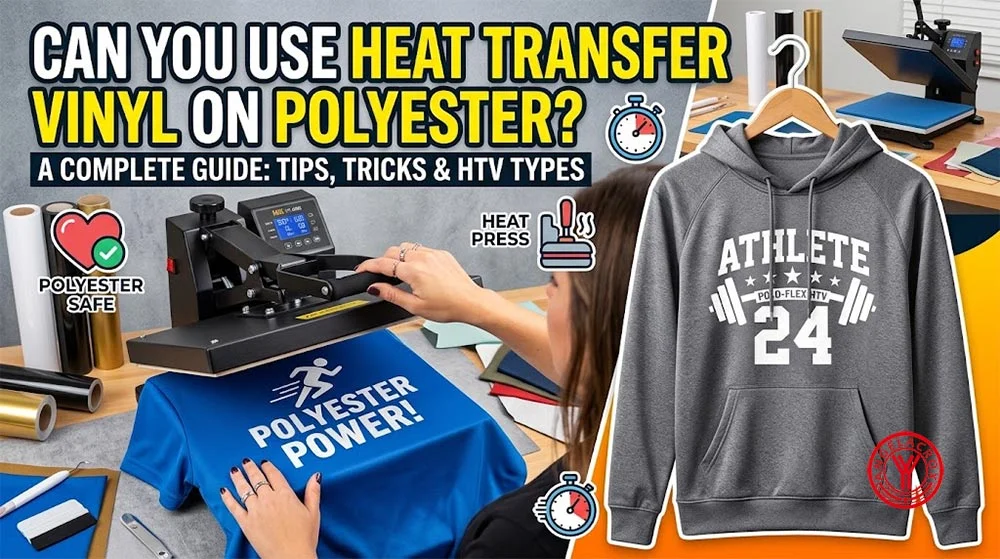
Why Polyester Needs Extra Care When Applying HTV
Polyester is widely used for sportswear, uniforms, promotional apparel, outdoor bags, and performance garments because it is lightweight, durable, and quick drying. At the same time, it is generally more sensitive to heat than cotton. A press setting that works on a cotton T-shirt can leave a shiny platen mark, flatten the fabric texture, change the garment color, or damage the surface of polyester.
Another important concern is dye migration. Polyester garments are commonly dyed with disperse dyes. When the fabric receives enough heat, especially in dark or highly saturated colors, some dye can move upward into the transfer layer. A white design may appear clean immediately after pressing but become pink, blue, gray, or yellow after the garment cools, sits for a day or two, or goes through a wash cycle.
Important: Lower application temperature can reduce dye-migration risk, but it does not guarantee that migration will not occur. For sublimated jerseys and high-risk dark polyester, use a dye-blocking or anti-sublimation HTV and complete a delayed inspection and wash test before bulk production.
Polyester Factors That Can Affect HTV Results
- Garment color: Red, maroon, royal blue, navy, black, fluorescent colors, and heavily dyed shades need more careful testing.
- Sublimation printing: Sublimated sportswear and jerseys have a higher dye-migration risk than many standard dyed polyester garments.
- Fabric construction: Mesh, thin performance fabric, textured knits, and polyester-spandex blends may need lower heat, lower pressure, or a more elastic film.
- Surface coatings: Water-repellent, stain-resistant, silicone, and other fabric finishes can interfere with adhesive bonding.
- Heat press performance: The temperature shown on a heat press controller may not match the actual temperature across the full platen.
Can PU, PVC, and TPU Heat Transfer Vinyl Be Used on Polyester?
Yes. PU, PVC, and TPU heat transfer vinyl can all be used on selected polyester garments. However, polymer type alone does not determine whether a film will work. A PU, PVC, or TPU film can perform differently depending on its thickness, plasticizer system, hot-melt adhesive, application temperature, carrier construction, and dye-blocking design.
In many polyester applications, PU and TPU-based films are preferred when a softer hand feel, flexibility, or lower-temperature application is needed. PVC HTV may still be suitable for standard polyester garments when the film is approved for polyester and the garment does not require high stretch or an especially soft feel. For dark or sublimated polyester, material selection should focus on dye-migration resistance rather than polymer type alone.
| HTV Material | Can It Be Used on Polyester? | Typical Advantages | Important Limitations and Checks |
|---|---|---|---|
| PU Heat Transfer Vinyl | Yes, for many polyester garments when the product is rated for polyester. | Usually offers a soft hand feel, good flexibility, clean cutting performance, and broad use on apparel and sportswear. | Check the required press temperature and dye-migration performance. Standard PU HTV is not automatically suitable for sublimated polyester or high-risk dark garments. |
| TPU Heat Transfer Vinyl | Yes, especially for performance apparel, stretch fabrics, and polyester-spandex blends when the product is designed for those applications. | Often provides strong elasticity, soft feel, durability, and good recovery after stretching. It is commonly considered for sportswear, activewear, logos, names, and flexible branding. | TPU performance varies by adhesive system and film construction. Test adhesion, stretch recovery, heat sensitivity, and dye migration on the actual garment before production. |
| PVC Heat Transfer Vinyl | Yes, for selected standard polyester garments if the product is specifically approved for polyester. | Can be a practical option for bold graphics, basic lettering, and cost-sensitive decoration projects where high stretch and an ultra-soft hand feel are not the main requirements. | PVC HTV may be less suitable for highly elastic performance wear or heat-sensitive polyester. Confirm the required temperature, flexibility, hand feel, and compliance requirements before use. |
For dark, bright, or sublimated polyester, do not select a film only because it is PU, PVC, or TPU. Instead, confirm whether the product is designed for low-temperature application and whether it includes a dye-blocking layer or has been validated for sublimation-resistant performance.
Which Heat Transfer Vinyl Is Best for Polyester?
There is no universal "best HTV for polyester." The right choice depends on the garment color, stretch level, dye-migration risk, and surface treatment. For buyers comparing different film types, our Heat Transfer Vinyl collection provides options for standard garment decoration, stretch applications, special-effect designs, and more demanding apparel conditions.
| Garment Type or Situation | Recommended HTV Type | Suitable Material Direction | Key Production Check |
|---|---|---|---|
| Light-colored, plain polyester | Standard HTV approved for polyester | PU HTV, TPU HTV, or PVC HTV may be suitable when the selected product is rated for polyester. | Check for heat marks and confirm adhesion with a sample press. |
| Lightweight or heat-sensitive polyester | Low-temperature HTV | Low-temperature PU or TPU-based HTV is often preferred when reduced heat exposure and a softer hand feel are important. | Confirm stable adhesion at the lower application temperature. |
| Polyester-spandex or performance stretchwear | Stretch HTV or elastic HTV | TPU HTV or stretch PU HTV is generally the better starting point because the film needs to stretch and recover with the garment. | Stretch-test the decorated area after pressing and after washing. |
| Dark or bright polyester | Low-temperature HTV or dye-blocking HTV | Use a polyester-compatible PU, TPU, or PVC film only after confirming its heat requirement and dye-migration resistance. | Inspect white or light graphics again after 24–48 hours. |
| Sublimated jerseys and teamwear | Dye-blocking or anti-sublimation HTV | Choose a dye-blocking PU or TPU-based solution designed for sublimated polyester. Do not assume standard PU, PVC, or TPU HTV will block dye migration. | Complete delayed inspection and wash testing on the actual jersey. |
| Water-repellent or coated polyester | HTV designed for coated or difficult fabrics | The polymer type alone is not enough; select a film and adhesive system verified for the garment finish. | Test adhesion and wash durability before accepting the order. |
For sublimated jerseys, do not treat ordinary PU HTV as a guaranteed solution. A standard film may initially adhere well and still show discoloration later. Dye-blocking HTV usually includes a barrier layer intended to limit dye movement, but it should still be tested because garment dyes, heat presses, storage conditions, and wash conditions can vary.
For dark, sublimated, or heat-sensitive sportswear, a dedicated polyester HTV vinyl range is generally a better material category to evaluate than a general-purpose film selected only by color or finish.
Heat Press Settings for Polyester HTV
The correct temperature, pressing time, pressure, and peel method should always follow the technical data sheet for the specific HTV product. Do not use one fixed polyester heat press setting for every vinyl. Different PU, PVC, and TPU films can use different adhesive systems, carrier sheets, and application methods.
Many polyester-oriented HTV products apply within a lower-temperature range of approximately 130–150°C (265–305°F) for around 10–15 seconds. This is only a general reference range, not a universal production setting. A low-temperature PU or TPU film, stretch HTV, dye-blocking HTV, PVC HTV, or specialty-effect film may require different settings.
| Control Point | Recommended Practice | Why It Matters |
|---|---|---|
| Temperature | Use the lowest temperature allowed by the selected HTV when heat sensitivity or dye migration is a concern. | Lower heat exposure can reduce shine marks, scorching, and dye activation. |
| Pressing time | Use the time recommended for the film. Do not extend press time automatically to compensate for poor adhesion. | Too much dwell time can increase the chance of heat damage and dye migration. |
| Pressure | Use even pressure and level the print area with a suitable pressing pillow when seams, zippers, or uneven surfaces are present. | Uneven pressure is a common reason for incomplete bonding and lifted edges. |
| Pre-press | Keep pre-pressing brief or omit it where the garment and HTV instructions allow. | Long pre-pressing can add unnecessary heat and create visible platen marks. |
| Peel method | Peel hot, warm, or cold according to the HTV supplier's instructions. | The wrong peel stage can distort the design or weaken the adhesive bond. |
| Finishing press | Use only if required, and keep it short with a suitable cover sheet. | A finishing press may improve bonding, but excessive repressing can raise migration risk. |
Production tip: Check your heat press with temperature-testing tools on a regular schedule. A heat press set to 150°C may not deliver the same temperature in the center, corners, and edges of the platen. Inconsistent platen temperature can create inconsistent production results.
How to Test HTV on Polyester Before Bulk Production
A quick peel test is not enough for polyester production. Use the actual garment color, garment lot where possible, HTV color, artwork size, and heat press that will be used for the order. Record the approved settings so the result can be reproduced consistently.
Recommended Polyester HTV Test Procedure
- Confirm the garment composition, color, fabric finish, stretch level, and whether the garment is sublimated.
- Confirm the selected PU, PVC, or TPU film is rated for the intended fabric and application.
- Apply the intended HTV using the supplier's recommended temperature, time, pressure, and peel method.
- Inspect the garment surface immediately for shine marks, texture changes, distortion, or color changes.
- Check the transfer for incomplete bonding, raised edges, carrier-sheet marks, or adhesive failure.
- Leave the sample for 24–48 hours and inspect white or light graphics for delayed dye migration.
- Wash the garment according to its care instructions and inspect adhesion, cracking, lifting, and discoloration after drying.
- Record the HTV type, film batch, temperature, time, pressure, peel method, heat press model, and operator for future production reference.
When working with coated fabrics, a water-drop observation can be used as an early screening method. If water remains highly rounded and rolls off easily, the garment may have a strong water-repellent finish. This does not replace a complete HTV application and wash test, but it helps identify a potential adhesion risk before production begins.
Common HTV Problems on Polyester and How to Fix Them
1. The Garment Has a Shiny Press Mark
A shiny square or visible platen mark usually indicates that the polyester surface received too much heat, pressure, or both. Use a lower-temperature compatible HTV where possible, reduce unnecessary pre-pressing, use a suitable cover sheet, and test before applying the design to the full order.
2. White HTV Turns Pink, Blue, Gray, or Yellow
This is a common dye-migration symptom. It may not appear immediately after pressing. Inspect the sample again after 24–48 hours and after washing. For dark polyester, sublimated uniforms, and high-risk athletic garments, use a dye-blocking HTV rather than relying on standard PU, PVC, or TPU HTV.
3. HTV Edges Lift After Pressing or Washing
First check actual platen temperature, pressure, pressing surface, and peel timing. If the garment has a water-repellent or silicone-related coating, standard HTV adhesive may not be compatible. Do not automatically increase heat or pressing time, because that may create a new problem such as scorch marks or dye migration.
4. The Graphic Cracks or Feels Too Rigid
A rigid HTV may not be suitable for a high-stretch garment, or the design may be too large for the garment's stretch zone. Choose a stretch-rated PU or TPU HTV, reduce heavy layering where possible, and test the decorated area under normal extension before production.
Frequently Asked Questions
Can you use PU heat transfer vinyl on polyester?
Yes. PU HTV can be used on many polyester garments when the product is approved for polyester and the application is tested. Standard PU film is not automatically suitable for dark, sublimated, coated, or high-risk polyester; confirm the temperature requirement and dye-migration performance first.
Can you use PVC heat transfer vinyl on polyester?
Yes, on selected standard polyester garments when the PVC film is approved for polyester. It may be less suitable for heat-sensitive fabrics, high-stretch performance apparel, or projects that require a very soft hand feel. Always confirm the film specification and conduct a sample press.
Can you use TPU heat transfer vinyl on polyester-spandex?
Yes. TPU HTV can be a good choice for polyester-spandex and performance wear when it is designed for stretch applications. Test adhesion and stretch recovery after pressing and after washing to verify performance on the actual garment.
What temperature should I use for HTV on polyester?
Use the temperature stated in the selected HTV product's application instructions. Many polyester-compatible films use lower settings in the range of 130–150°C (265–305°F), but this is not a universal rule. Always test the specific PU, PVC, or TPU film and garment combination before full production.
Can low-temperature HTV prevent dye migration?
Low-temperature HTV can reduce dye-migration risk by limiting heat exposure, but it does not guarantee complete prevention. For sublimated jerseys and high-risk dark polyester, use a dye-blocking HTV and complete delayed inspection and wash tests.
How long should I wait before washing polyester with HTV?
Follow the HTV supplier's care instructions. In many cases, waiting at least 24 hours before the first wash helps the adhesive stabilize. Turn the garment inside out, avoid harsh washing conditions, and avoid high-heat drying unless the HTV and garment care instructions specifically allow it.
Key Takeaway
Heat transfer vinyl works on polyester when the material selection and application process match the garment. PU, PVC, and TPU HTV can all be used on selected polyester applications, but each material should be chosen according to garment stretch, heat sensitivity, required hand feel, decoration type, and dye-migration risk.
For routine light-colored polyester, a polyester-approved PU, PVC, or TPU film may work well after a sample press. For polyester-spandex and performance garments, stretch PU or TPU HTV is often the more suitable direction. For dark, brightly dyed, or sublimated polyester, prioritize low-temperature and dye-blocking performance rather than selecting material only by polymer type.
If you are selecting material for polyester apparel, start with polyester heat transfer vinyl solutions developed for polyester-focused applications. For a wider selection of films for cotton, blends, sportswear, fashion decoration, and specialty projects, explore the complete Heat Transfer Vinyl collection.
The most dependable production decision is based on the actual garment and a documented test—not the fiber label alone.
Editorial note: This guide provides practical general information. Always follow the latest technical data sheet and care instructions for the exact HTV product and garment being used.